

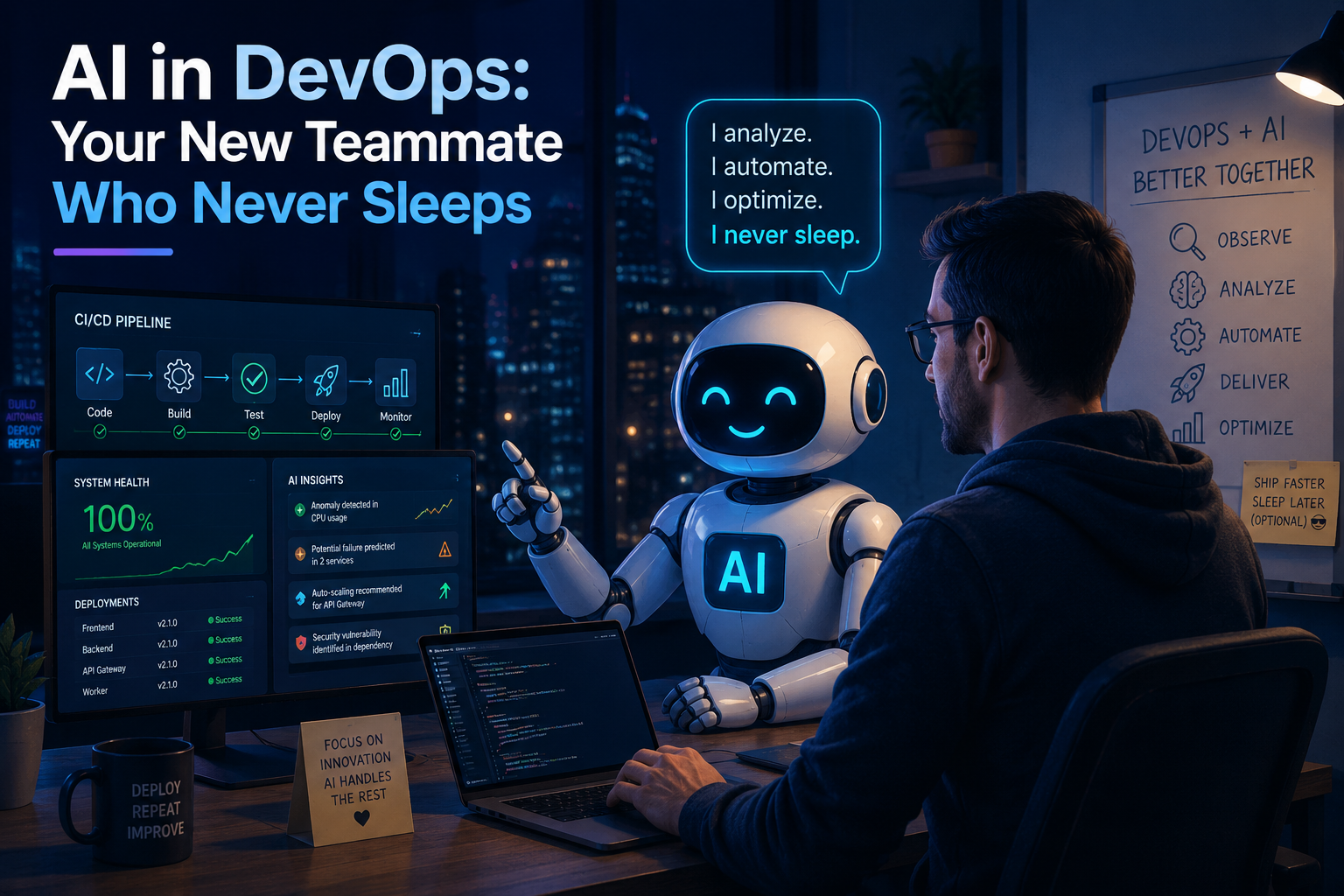
How artificial intelligence is quietly transforming the way teams build, ship, and run software — without replacing the humans doing it.
Imagine having a colleague who monitors your entire production environment at 3 a.m., catches a weird memory spike before it becomes an outage, writes the fix suggestion, and then files the ticket — all before you've had your morning coffee. That's not science fiction anymore. That's what AI is starting to do inside modern DevOps teams.
But let's be honest: "AI in DevOps" sounds either terrifying or like a buzzword salad, depending on your mood. So let's break it down — plainly, practically, and without the hype.
"AI doesn't replace your DevOps team. It gives them superpowers they didn't have time to build themselves."
1. Catching problems before they become fires
Traditional monitoring works like a smoke alarm — it screams when something's already burning. AI-powered observability is more like a smoke detector that notices the candle flickering near the curtain ten minutes earlier.
Tools like AIOps platforms analyze massive streams of logs, metrics, and traces in real time. They learn what "normal" looks like for your system, and flag anomalies long before your on-call engineer's phone buzzes. This means fewer 2 a.m. incidents and faster mean-time-to-resolution when things do go sideways.
Examples
- Predicting traffic spikes before they hit capacity limits
- Correlating an error spike to a deployment that happened 20 minutes ago
- Grouping thousands of noisy alerts into a handful of actual problems
2. Smarter, faster CI/CD pipelines
Every developer knows the pain of waiting 45 minutes for a pipeline to finish only to find out it failed in the last step. AI can make pipelines dramatically smarter by predicting which tests are most likely to fail based on what code changed — and running those first.
AI can also detect flaky tests (tests that randomly fail without any real bug), prioritize build steps intelligently, and even suggest pipeline configuration improvements based on historical data. Less waiting, more shipping.
3. Writing the boring stuff so humans don't have to
A huge chunk of DevOps work is repetitive: writing Terraform configs, Kubernetes manifests, Helm charts, Docker files, runbooks. AI code assistants (think GitHub Copilot, Claude, or similar tools) are genuinely good at generating this kind of boilerplate quickly and correctly.
This isn't about replacing engineers. It's about freeing them from the mechanical, copy-paste-tweak work so they can focus on the decisions that actually require a human brain — architecture, trade-offs, security considerations.
Where AI writes so you don't have to
- Infrastructure-as-code templates (Terraform, CloudFormation)
- CI/CD pipeline definitions (GitHub Actions, GitLab CI, Jenkins)
- Kubernetes manifests and Helm charts
- Incident runbooks and post-mortem templates
- Shell scripts for repetitive automation
4. Security that keeps up with the speed of deployment
Teams deploying dozens of times a day can't have security reviews bottlenecked by a single human. AI-powered security tools scan code and infrastructure configs for vulnerabilities in seconds, flag suspicious patterns, and can even auto-remediate common misconfigurations.
This is often called "shift-left security" — catching issues early, in the pipeline, instead of after deployment. AI makes it feasible at the speed modern DevOps teams actually operate.
5. Incident response that doesn't rely on tribal knowledge
When something breaks at scale, the clock is ticking and every second matters. AI-assisted incident response tools can surface relevant runbooks automatically, suggest likely root causes based on past incidents, and even draft the status page update while your engineers are in the war room.
Over time, these systems learn from every incident your team resolves — building up institutional knowledge that doesn't walk out the door when a senior engineer leaves.
6. Capacity planning without the crystal ball
Guessing how much infrastructure you'll need next quarter used to require spreadsheets, gut instinct, and a fair amount of luck. AI forecasting models analyze historical usage patterns alongside external signals — seasonal trends, product launch calendars, marketing campaigns — and produce much more reliable capacity forecasts.
The result? Less over-provisioning (which wastes money) and less under-provisioning (which causes outages).
What AI can't do (and shouldn't)
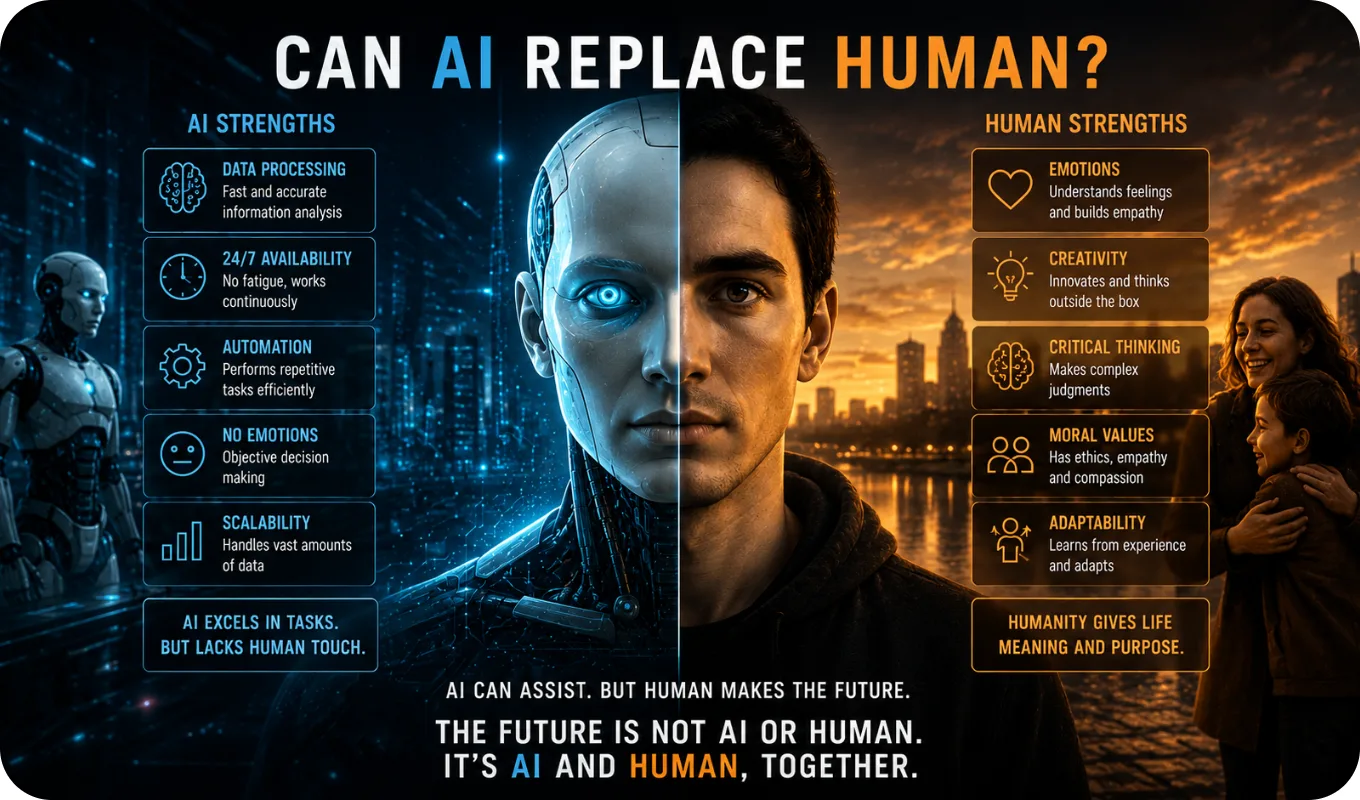
AI is genuinely useful in DevOps. But it's not a magic button. It still requires human judgment for architectural decisions, it can be confidently wrong, and it doesn't understand your business context unless you teach it. The best DevOps teams use AI to handle volume and speed, while keeping humans in the loop for anything consequential.
Think of it less like handing over the controls and more like getting a very capable co-pilot. One who reads dashboards faster than you, never gets tired, and has memorized every incident your team has ever had — but still needs you to decide where the plane is going.
A practical starting point
- Start with AI-assisted code generation for IaC and pipelines
- Add AIOps tooling to your observability stack for smarter alerting
- Use AI security scanning in your CI/CD pipeline
- Gradually introduce AI-driven capacity planning as you collect data
- Let AI draft runbooks — but have humans review and own them
The teams winning at DevOps today aren't the ones with the most engineers. They're the ones who've figured out how to multiply what each engineer can do. And right now, AI is the most powerful multiplier on the table.
Comments (0)
Log in or register to leave a comment.
No comments yet. Be the first to comment!