

Artificial intelligence is no longer a futuristic concept — it's embedded in hiring decisions, healthcare diagnostics, financial systems, and everyday consumer products. And as AI grows more powerful and pervasive, one uncomfortable truth is becoming impossible to ignore: most organizations are adopting AI far faster than they're managing it.
That's where ISO/IEC 42001 comes in.
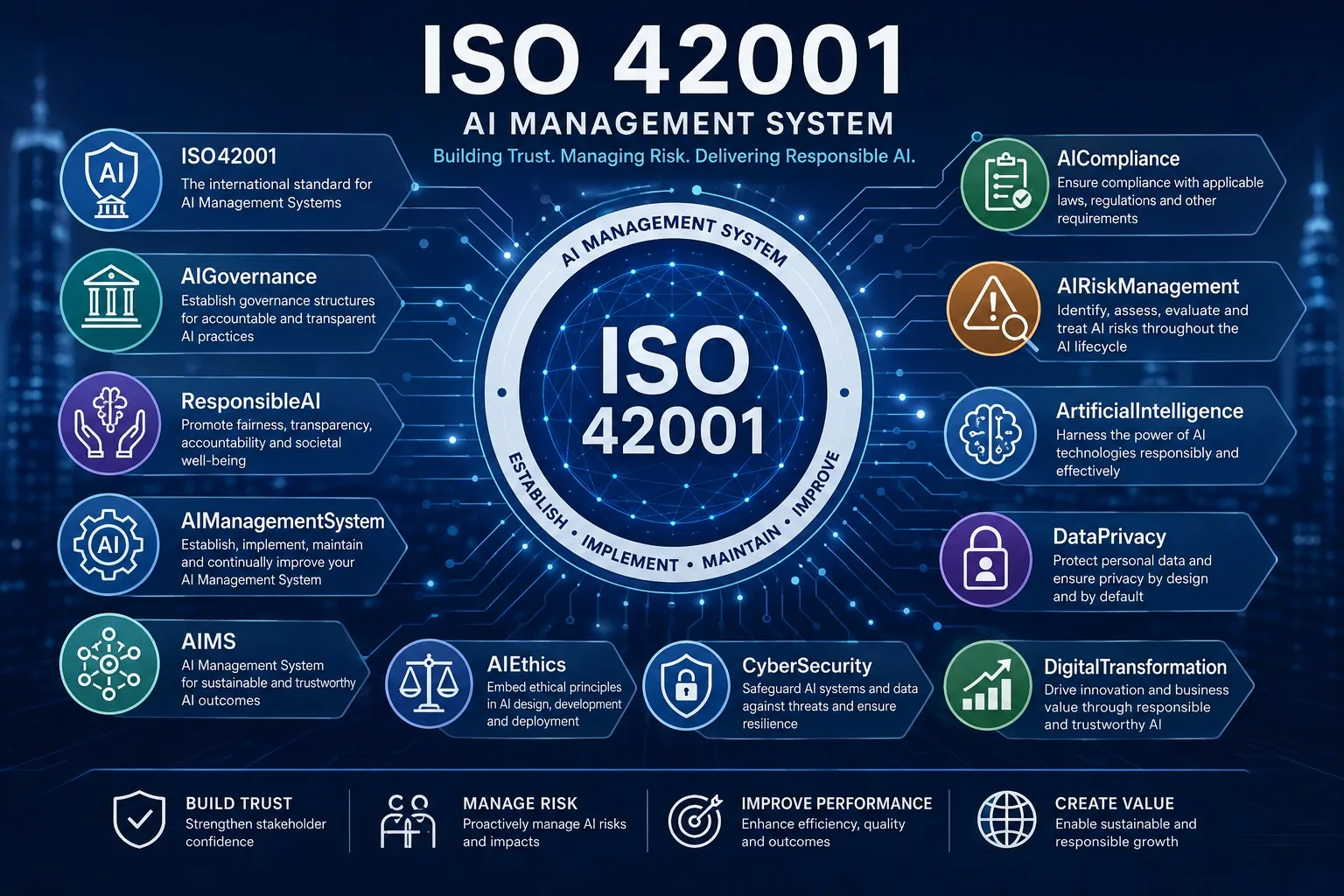
This landmark standard — the world's first international framework specifically designed for AI Management Systems — gives organizations a structured, auditable way to develop, deploy, and govern AI responsibly. Think of it as the rulebook that AI adoption has desperately needed.
Let's break it all down in plain, human language.
What Exactly Is ISO/IEC 42001?
ISO/IEC 42001 is an internationally recognized standard that defines the requirements for an AI Management System (AIMS). Published by the International Organization for Standardization (ISO) and the International Electrotechnical Commission (IEC), it provides organizations with a clear framework for managing AI responsibly — covering everything from governance and risk to transparency and continuous improvement.
If you've ever worked with ISO 27001 (information security) or ISO 9001 (quality management), the structure will feel familiar. But this one is built from the ground up for the unique challenges that AI brings to the table.
At its heart, ISO 42001 is about one thing: moving AI from experimentation to controlled, measurable, and auditable operations.
Why Does It Matter? The Real Risks of Unmanaged AI
Organizations are racing to adopt AI — and that race is creating real blind spots. Here are the core risks that ISO 42001 is designed to address:
Bias & Fairness
AI systems learn from historical data. If that data reflects past discrimination or systemic bias, the AI will likely replicate and sometimes amplify those patterns. The result? Unfair or discriminatory outcomes in hiring, lending, healthcare, law enforcement, and more. Without a formal process to identify and address bias, organizations can cause serious harm — often without even realizing it.
Security Risks
AI models, the data they're trained on, and the infrastructure that runs them are all potential attack surfaces. Adversarial inputs can manipulate model behavior. Sensitive training data can be extracted. Pipelines can be compromised. Security risks in AI aren't hypothetical — they're happening right now, and most organizations don't have adequate controls in place.
Privacy Concerns
Many AI systems process enormous volumes of personal and sensitive data. Without careful governance, that data can be misused, over-retained, or exposed. In a world of tightening privacy regulations, mishandling data in AI pipelines isn't just an ethical problem — it's a legal one.
Regulatory Pressure
Governments and regulators around the world are moving quickly to establish rules around AI. The EU AI Act is already in motion. Other jurisdictions are following suit. Organizations that don't build governance structures now will find themselves scrambling to comply later — at much greater cost and disruption.
Operational Risk
AI systems can fail in ways traditional software doesn't. Hallucinations, unreliable outputs, model drift, unexpected edge cases — these aren't bugs in the traditional sense, but they can cause real operational damage if there's no system to detect and respond to them.
Reputational Impact
Perhaps most immediately felt: a single high-profile AI failure — a biased decision, a privacy breach, a discriminatory outcome — can cause enormous and lasting damage to trust and brand value. Companies that can demonstrate responsible AI governance have a clear competitive and reputational advantage.
ISO 42001 helps organizations manage all of these risks in a systematic, repeatable, and auditable way. Not by slowing AI down, but by making it trustworthy.
The Key Control Areas: What ISO 42001 Actually Covers
The standard is organized around ten key control areas, each designed to address a specific dimension of responsible AI management:
1. AI Governance
This is the foundation. ISO 42001 requires organizations to establish a clear AI governance structure — defining roles, responsibilities, and decision-making rights. Someone needs to be accountable for AI decisions, and that accountability needs to be formalized and documented.
2. AI Risk Management
AI introduces a distinct risk profile that traditional enterprise risk frameworks weren't designed to handle. The standard requires organizations to identify, assess, treat, and monitor AI-specific risks throughout the full AI system lifecycle — from initial design through deployment and eventual decommissioning.
3. AI Impact Assessment
Before deploying an AI system, organizations need to think carefully about what could go wrong — and for whom. This control area requires structured evaluation of potential impacts on people, society, the economy, and the environment. It's essentially a pre-deployment due diligence process.
4. Data Governance
Garbage in, garbage out — and far worse consequences when the "garbage" is biased, stale, or mismanaged data. ISO 42001 requires organizations to ensure data quality, traceability (lineage), privacy, security, and appropriate use throughout the AI pipeline. Strong data governance isn't optional; it's foundational.
5. Model Management
AI models aren't static assets. They drift, degrade, and behave differently as the world changes around them. The standard requires organizations to validate, test, monitor, and continuously improve their AI models and systems — treating them as living artifacts that need ongoing attention.
6. Transparency & Explainability
If your AI makes a decision, can you explain why? This control area requires organizations to provide clear information about AI capabilities, limitations, and decision logic. In some contexts — healthcare, finance, HR — this isn't just best practice. It's increasingly a legal requirement.
7. Human Oversight
Not all AI decisions should be fully automated. ISO 42001 requires organizations to maintain appropriate human-in-the-loop or human-on-the-loop controls — ensuring that humans remain meaningfully involved in consequential decisions, especially where errors could cause harm.
8. Security & Privacy
AI systems, their data, and their outputs need to be protected from unauthorized access and misuse. This control area extends traditional cybersecurity and privacy thinking into the AI-specific context — covering model security, data protection, and output integrity.
9. Incident Management
When AI systems go wrong — and they will — organizations need to be ready to detect, respond, and learn. ISO 42001 requires a formal incident management process for AI-related issues: identifying what happened, containing the damage, and using the experience to improve future practice.
10. Continual Improvement
Like all ISO management system standards, 42001 isn't a one-and-done certification. Organizations must continuously monitor performance and effectiveness, and actively work to improve their AI management systems over time. The standard is designed to grow with the organization and the technology.
The Benefits: What Organizations Actually Gain
Implementing ISO 42001 isn't just about checking a compliance box. The real benefits are practical and substantial:
- Builds trust in AI systems. Customers, partners, regulators, and employees are all more likely to trust AI systems that operate within a recognized international framework. Certification is a visible signal of responsible practice.
- Ensures regulatory compliance. The standard is designed to align with emerging AI regulations globally. Organizations that implement AIMS are better positioned to comply with the EU AI Act, national AI policies, and sector-specific requirements — now and as new rules emerge.
- Improves AI quality and reliability. Systematic model management, incident response, and continual improvement don't just reduce risk — they make AI systems perform better and more consistently over time.
- Promotes ethical AI adoption. ISO 42001 embeds ethical considerations — fairness, transparency, human oversight — into the operational fabric of AI development and deployment, rather than treating them as afterthoughts.
- Enhances risk visibility. One of the most common challenges in AI governance is simply not knowing what you don't know. The standard creates structured processes for surfacing, assessing, and addressing AI risks that might otherwise go unnoticed.
- Strengthens operational resilience. By formalizing processes around AI lifecycle management and incident response, organizations become more resilient when things go wrong — because they have the systems to catch problems early and respond effectively.
- Protects privacy and data. Robust data governance requirements help organizations handle sensitive data responsibly — reducing exposure to breaches and regulatory penalties.
- Supports global standards alignment. For multinational organizations, operating within an internationally recognized standard simplifies compliance across jurisdictions and simplifies conversations with global partners and regulators.
Who Should Care About ISO 42001?
The short answer: anyone whose organization develops, deploys, or is materially affected by AI systems. But more specifically:
- CISOs and CTOs — AI expands the security and technology risk surface significantly. ISO 42001 gives security and technology leaders a framework for managing that surface systematically.
- AI/ML Teams — Data scientists and ML engineers often want to build responsibly but lack the organizational structure to do so consistently. The standard provides that structure, making responsible AI a team capability rather than an individual effort.
- Risk & Compliance Professionals — AI is rapidly becoming a major compliance domain. ISO 42001 aligns AI governance with existing risk management frameworks and provides the documentation structure needed for audits and regulatory inquiries.
- Data Governance Teams — The standard's data governance requirements directly intersect with existing data management responsibilities, giving data teams clear authority and accountability for AI-related data practices.
- Business Leaders — Ultimately, AI governance is a business responsibility. Leaders who understand and champion ISO 42001 are better positioned to deliver AI value without the reputational, legal, and operational risks that come with ungoverned AI deployment.
From Innovation to Responsible AI
ISO 42001 gives organizations the tools to do it proactively: to govern AI responsibly, manage risk before it becomes crisis, and create genuine value with the confidence that comes from knowing your systems are trustworthy, auditable, and continuously improving.
AI is one of the most transformative technologies in human history. That transformation can go many different ways — and the choices organizations make now about how to govern AI will shape the outcomes for years to come.
ISO/IEC 42001 is the first international consensus on what responsible AI management actually looks like in practice. It's not perfect, and it's not a silver bullet. But for organizations serious about building trustworthy AI at scale, it's the most important framework available today.
Stay informed. Stay secure.
Follow Video Series on YouTube
Comments (0)
Log in or register to leave a comment.
No comments yet. Be the first to comment!