

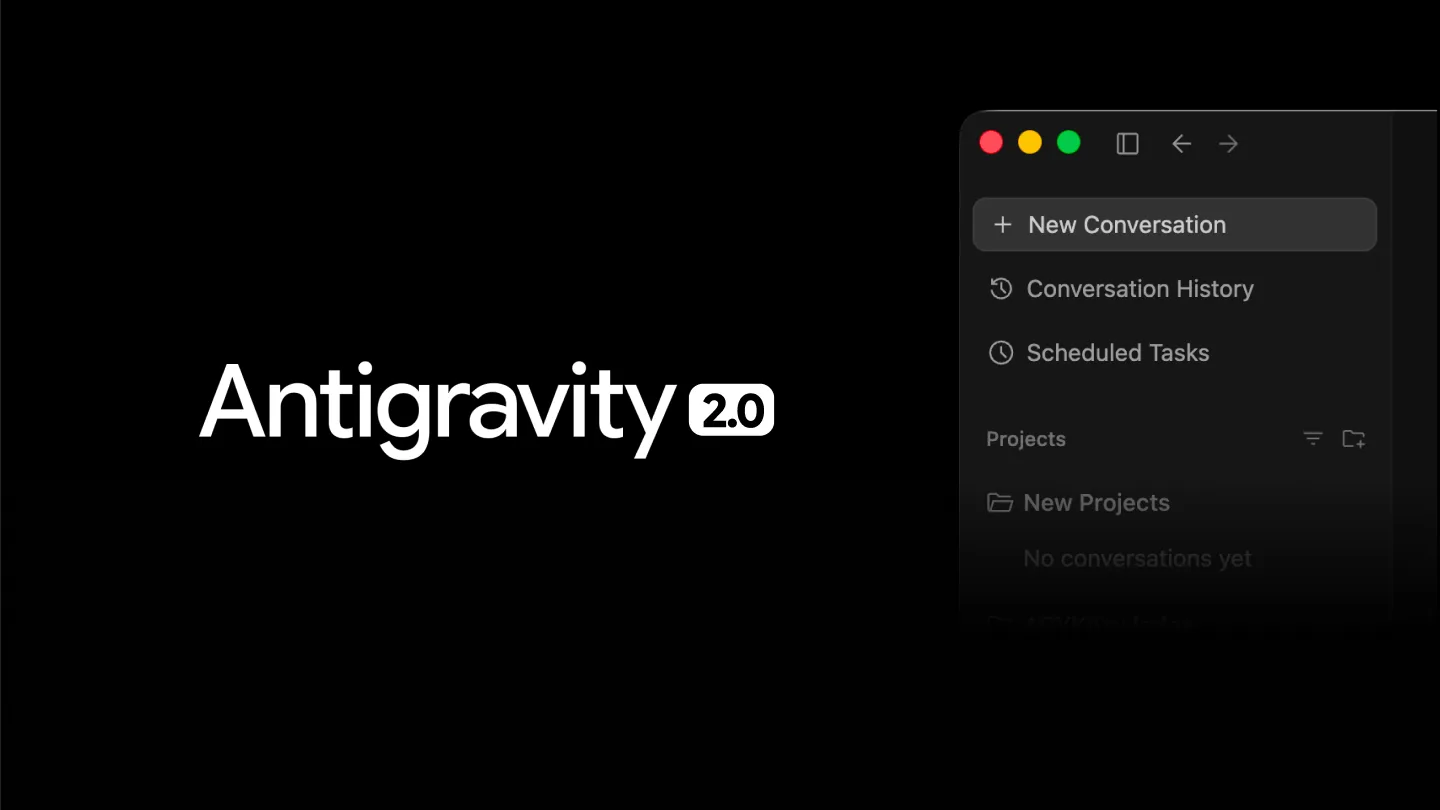
Just days after Google I/O 2026, the landscape of AI-assisted coding has dramatically shifted. Moving away from the traditional model of bolting an AI chat window onto a standard code editor, Google has launched Antigravity 2.0—a standalone, unabashedly agent-first desktop application.
Powered by the blistering speed of the newly announced Gemini 3.5 Flash, Antigravity 2.0 isn't just an assistant; it's a platform for orchestrating teams of autonomous AI agents capable of handling complex, long-running engineering tasks.
What Makes Antigravity 2.0 Different?
The future of software development requires moving beyond simple auto-complete. Antigravity 2.0 shifts the focus to multi-agent orchestration, asynchronous task management, and verifiable artifacts.
Here are the standout benefits and features of the 2.0 release:
- Dynamic Subagents: The primary agent no longer has to handle everything within a single, cluttered context window. It can dynamically define, spin up, and invoke specialized subagents to tackle focused subtasks in parallel, dramatically improving both speed and output quality.
- Asynchronous Task Management: You don't have to wait for the agent to finish compiling or running tests. Tasks run asynchronously in the background, freeing up the main agent (and you) to continue working uninterrupted.
- Scheduled Tasks (Cron for Agents): You can now define a cron schedule to trigger Antigravity agents automatically. Whether it's running routine security checks, updating dependencies, or scraping daily data, the agents operate autonomously without manual invocation.
- Project-Level Scoping: Agents are no longer tied to a single repository. Conversations are now grouped by "Projects," which can span multiple folders and enforce custom settings, JSON hooks, and scoped permissions.
- Live Voice Transcription: Instead of recording audio files to send to a model, the native voice input uses Gemini Audio models to provide real-time transcription, converting your spoken thoughts into clearly phrased prompts instantly.
The Power of Gemini 3.5 Flash
Under the hood, Antigravity 2.0 runs on Gemini 3.5 Flash, optimized specifically for agentic workflows. Speed is the headliner here: clocking in at an impressive 289 output tokens per second, it massively outpaces competitors like Claude Opus 4.7 and GPT-5.5.
To prove its capabilities live at Google I/O, the team demonstrated Antigravity 2.0 building the core of an operating system from scratch in just 12 hours—using less than $1,000 in tokens. The system launched 93 separate sub-agents to divide and conquer the architecture.
A New Workflow
By stripping away the legacy baggage of traditional IDEs, Antigravity 2.0 forces a paradigm shift. You manage agents, review the Artifacts they produce, and provide course corrections through custom slash commands like /goal (run to completion) or /grill-me (force the agent to ask clarifying questions before touching a file).
Available now for macOS, Windows, and Linux, Antigravity 2.0 represents the most significant leap yet toward truly autonomous AI engineering teams.
#GoogleIO #Antigravity2 #AI #SoftwareEngineering #GeminiFlash #DeveloperTools #TechNews
Comments (0)
Log in or register to leave a comment.
No comments yet. Be the first to comment!