

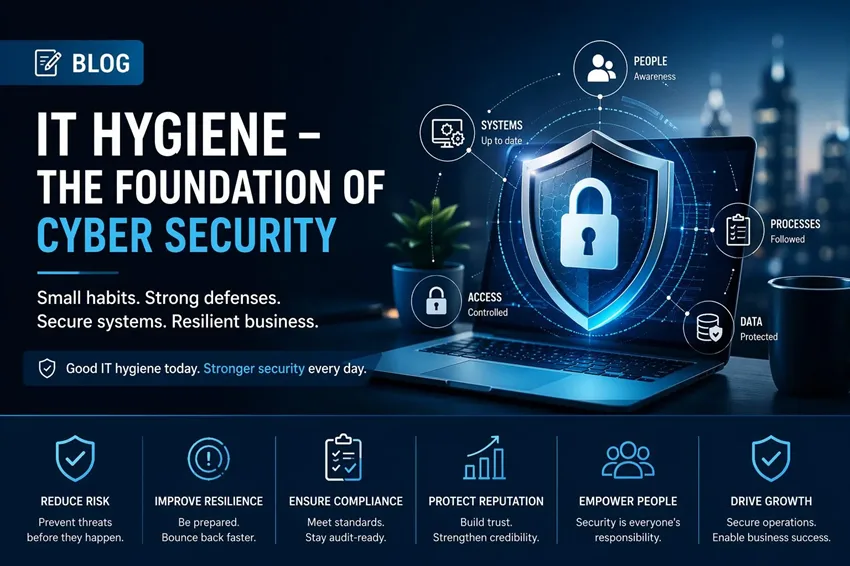
Modern attackers are no longer trying to break systems in complex ways. In most cases, they simply log in using weak, stolen, or unmanaged access. The gap between what organizations know they should do and what actually gets done is where breaches happen.
This is what we call poor IT hygiene — and it remains one of the biggest risks for any business.
The Reality of Today’s Threat Landscape
Despite advancements in AI-driven security tools and detection platforms, attackers continue to exploit simple weaknesses:
- Most breaches still start with compromised credentials or unpatched systems
- Many organizations take weeks to detect intrusions, giving attackers time to explore and escalate
- A large percentage of attacks exploit known vulnerabilities with available patches
- The financial impact of breaches continues to grow, costing organizations millions
These are preventable issues. The challenge isn’t lack of technology — it’s lack of consistency in execution.
The Most Common IT Hygiene Failures
1. Delayed Patching
Organizations often delay patching due to operational priorities. Meanwhile, attackers begin scanning and exploiting vulnerabilities almost immediately after disclosure.
Good practice:
- Critical vulnerabilities patched within 48–72 hours
- Regular patch cycles maintained consistently
2. Unmanaged Accounts and Access Sprawl
Unused service accounts, inactive user IDs, and shared credentials create silent entry points.
Common risks:
- Employees leaving but accounts remain active
- Overprivileged access granted “temporarily” but never removed
- Shared administrative credentials
Good practice:
- Strict joiner-mover-leaver (JML) processes
- Regular access reviews and least-privilege enforcement
3. Incomplete MFA Enforcement
Multi-factor authentication is one of the strongest defenses — but only when implemented everywhere.
Typical gaps:
- Legacy systems without MFA
- VPNs or admin portals excluded
- Executive exceptions
Good practice:
- MFA across all users, systems, and access points
4. Shadow IT and Untracked Assets
With remote work and rapid SaaS adoption, employees often use tools and devices outside IT visibility.
Risks include:
- Data leakage through unauthorized applications
- Unsecured personal devices accessing company systems
Good practice:
- Maintain a real-time asset inventory
- Implement approval workflows for new tools
5. Weak Monitoring and Logging
Most organizations generate logs but lack proper visibility or response capabilities.
Impact:
- Attackers can remain undetected for long periods
- Delayed incident response increases damage
Good practice:
- Centralized logging (SIEM)
- Active monitoring with alerts on anomalies
What Good IT Hygiene Looks Like Today
A strong hygiene baseline includes:
- Patch Management: Critical updates applied within 72 hours
- MFA Enforcement: No exceptions
- Access Reviews: Quarterly validation of permissions
- Asset Inventory: Complete visibility of all systems and devices
- Endpoint Protection: EDR deployed across all endpoints
- Offboarding: Immediate access revocation on exit
- Logging & Monitoring: Proactive alerting and analysis
- Password Policy: Strong, unique, and enforced via tools
- Backup & Recovery: Regular testing and 3-2-1 backup strategy
These are not advanced controls — they are the minimum expectations for a secure environment.
IT Hygiene Is an Ongoing Discipline
One of the biggest challenges is prioritization. Hygiene tasks often get delayed because they compete with business projects.
- Patch cycles are postponed due to deadlines
- Access reviews are skipped during busy periods
- Security improvements are labeled “non-urgent”
This approach creates risk over time.
Organizations that succeed treat IT hygiene as:
- Non-negotiable operational activity
- Measurable KPI-driven process
- Visible risk at leadership level
Governance: Making Hygiene Sustainable
Without governance, even well-designed controls fail over time.
Key governance practices include:
- Defined ownership for each hygiene area
- Monthly reviews of hygiene metrics
- Automation wherever possible (patching, offboarding, MFA)
- Formal exception management with risk acceptance
- Integration with risk registers and compliance frameworks
Frameworks like ISO 27001, ISO 42001, NIST, and CIS Controls provide strong guidance for structuring this.
The Growing Impact of AI Tools
AI adoption has introduced new hygiene challenges.
Tools like Copilot, ChatGPT, and other AI platforms are now widely used across departments, often without formal oversight.
New risks include:
- Sensitive data shared with external AI systems
- Lack of tracking of AI tool usage
- Unclear data handling policies
Recommended controls:
- Maintain an AI tool inventory
- Define acceptable use policies
- Update data classification frameworks
- Review vendor data handling practices
AI governance is now becoming a core part of IT hygiene.
Conclusion
The threat landscape continues to evolve, but the fundamentals remain the same.
Most successful attacks don’t rely on advanced techniques — they rely on gaps in basic security practices.
Strong IT hygiene comes down to simple, repeatable actions:
- Patch systems quickly
- Enforce MFA everywhere
- Remove unnecessary access
- Monitor continuously
- Maintain visibility of all assets
Organizations that consistently follow these practices become significantly harder targets.
Because in cybersecurity, it’s not always about having the most advanced tools — it’s about not leaving the easy doors open.

Comments (0)
Log in or register to leave a comment.
No comments yet. Be the first to comment!